
ISOLDE tapestation
The ISOLDE tapestation is the prime piece of equipment to perform the target yield checks and optimizations, as well as beam development tasks. It uses a tape system which allows the removal of activity from the implantation point and the transport to different detectors – up to now beta counting and gamma spectroscopy were employed.
After the removal of the previous Tapestation, which has served ISOLDE ford ecades, from the central beam line, the new Tapestation was moved to its final location from LA2 where it was first commissioned during 2018 ISOLDE operation. The Tapestation detection system was recently upgraded with new beta detectors based on silicon photomultiplier (SiPM) 3×3 arrays developed at IFIN-HH, Romania [2] with integrated amplification offering a low dark current and specifically designed to be operated at high counting rates (∼1 MHz). The SiPM ells employed are the 6×6 mm C-series manufactured by Sensl. The signals originating from the 9 cells are summed, filtered and amplified using low-power operational amplifiers which output two signals proportional to the amount of light collected: fast (15 ns rise time,100 ns decay time) and slow (100 ns rise time, 2μs decay time). The fast signals are sent to the ISOLDE counters and the slow signals will be digitized to extract the beta particles energy spectrum.
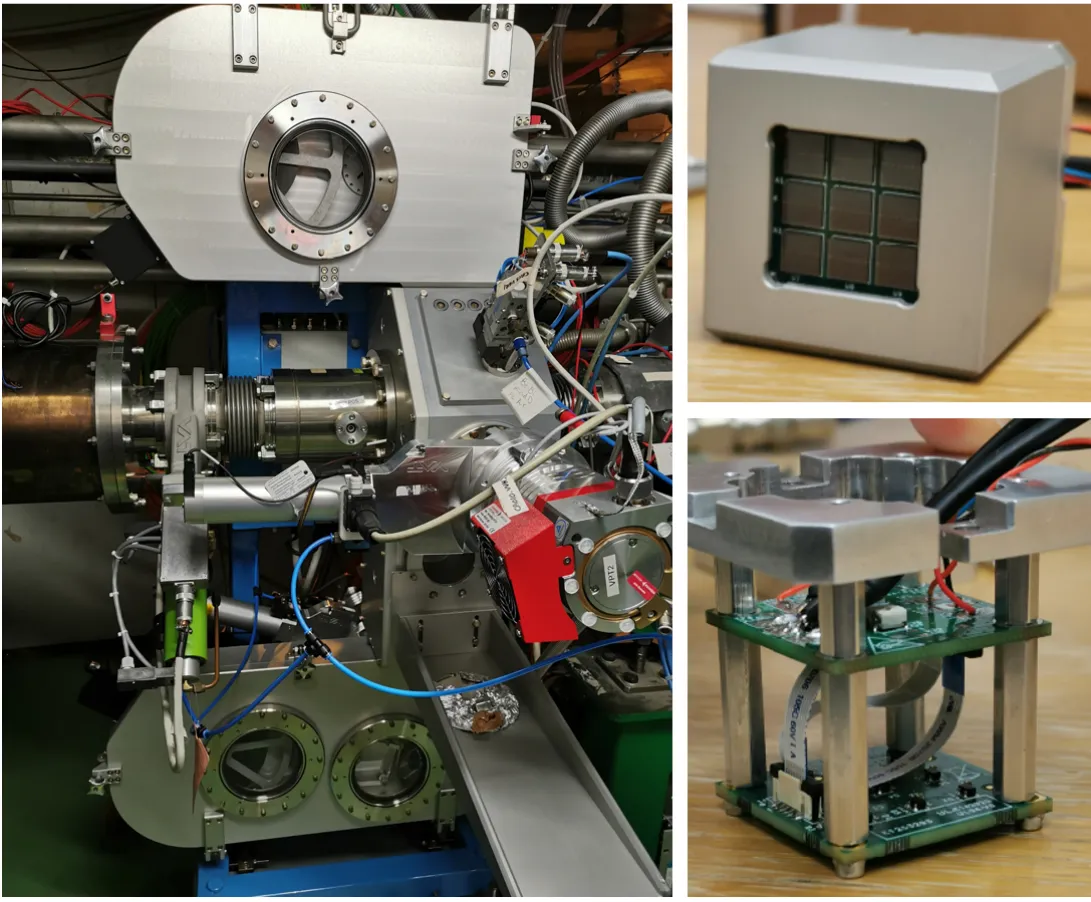
The SiPM arrays will be coupled to a 23x23x3 mmEJ200 plastic scintillator suitable for detecting beta-particles in the range of few tens of keV and up to one MeV, and tag on the beta-particles of higher energies which deposit only a part of their energy in the thin scintillator. In addition to the beta detectors, gamma-ray detection will be provided by the newly reconditioned Canberra HPGe detector used previously at the old Tapestation. The DAQ system is chosen such that alpha detection using a Si pad detector can be easily implemented at a later stage. The detectors will be placed in the following configuration:
- Position 0 (implantation position): one beta detector located behind the tape in the forward direction relative to the beam.
- Position 1 (4πbeta detection): two beta detectors facing each other with the tape passing in-between, offering the best geometric coverage of almost 4π. The detection system is surrounded by a thick Pb shielding to minimize the radiation background.
- Position 2 (beta-gamma detection – design phase): one beta detector facing the HPGe detector with the tape passing in-between, offering the possibility of beta-gamma coincidences reducing the background.
- Position 3 (alpha detection – design phase): one Si pad detector facing the implantation spot on the tape.
A new data acquisition system able to instrument all the detectors listed above was installed, based on the CAEN DT5725S with 14-bit resolution and 250 MS/s sampling rate, well suited for mid to fast signals, as the ones coming from scintillators coupled to PMTs or Silicon Photomultipliers, but also for high precision detectors such as Silicon or HPGe, coupled with charged sensitive preamplifiers. The previous Canberra system will be used while a deeper integration of the CAEN system into the CERN data acquisition is being developed.
References
[2] C. Mihai,et al.,Nuclear Instruments and Meth-ods in Physics Research Section A: Accelerators,Spectrometers, Detectors and Associated Equip-ment953, 163263 (2020)